


- Market / location
- China — documented corrugated-packaging installations; customer identities withheld
- Product / substrate
- Printed corrugated cartons and corrugated-board packaging blanks
- Verified result
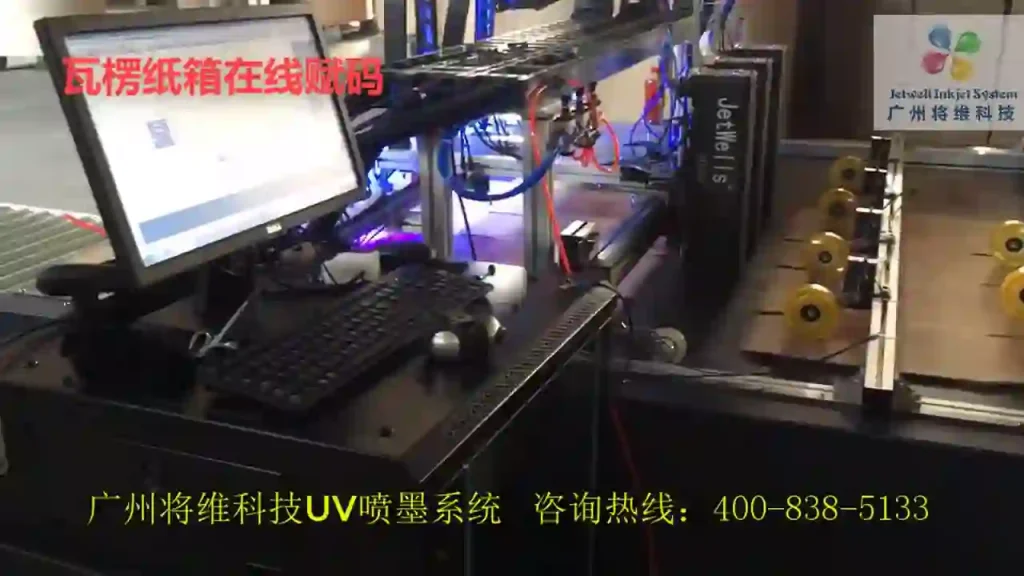
- Four production clips confirm inline carton transport, added print and UV-curing stations, and variable-code output. Exact speed and verification grade were not supplied.
Direct answer
An existing corrugated-carton line can often be upgraded with UV inkjet when it provides a repeatable product path, enough working distance for the printhead, an encoder signal and a safe curing position. These recorded installations show variable coding added to working carton lines instead of replacing the customer's main converting or printing equipment.
Documented application evidence
The video set includes close and wide views of corrugated material moving through installed coding stations. It shows the relationship between the transport, print modules and UV units, which is more useful for an integration buyer than a photograph of a loose printed carton.
Third-party branding visible in one source clip belongs to its owner and is shown only because it appears on the documented substrate. It does not imply endorsement or authorize a claim about that brand's production specifications.
Application overview
| Application | Post-print variable coding on corrugated packaging |
|---|---|
| Typical data | Unique QR codes, barcodes, lot data, serials and distribution information |
| Integration | Retrofit over an existing conveyor or board transport |
| Key controls | Flatness, product gap, encoder tracking and print distance |
| Curing | Shielded inline UV before stacking or contact |
| Evidence | Four production videos from actual line configurations |
Customer requirement and production challenge
Corrugated material is inexpensive but mechanically inconsistent. Warp, flute compression, joints and dust can change the head-to-product distance, while large cartons may enter the line with lateral movement. A code that looks acceptable on one flat sample may lose edge definition when the board rises or skews in production.
Variable campaigns also create a data-control requirement. The system must know when a carton is present, which record is assigned, what happens to a missed or rejected product and how operators resume after a stop without creating duplicates.
Inkjetwell integration approach
The retrofit starts with a line survey. Inkjetwell identifies a stable print span, measures height variation and determines whether guides, hold-down belts or a dedicated conveyor section are required. A sensor detects each carton, encoder feedback follows movement and the controller releases the correct variable record.
The UV unit is positioned after printing with guarding appropriate to the installation. Cure is checked before the printed surface touches a belt, guide, stack or pallet. Where several carton panels or lanes require coding, multiple modules can be positioned according to the actual artwork rather than a generic maximum width.
How buyers can use this evidence
Use the videos to compare your own line with the documented transports: identify where the carton becomes flat and stable, where a trigger and encoder can be installed, and how much distance remains before the printed face touches another surface. A useful first inquiry includes a side-view line video, carton dimensions, code artwork and the normal speed range. With those inputs, Inkjetwell can separate a simple module retrofit from a project that also needs guides, a dedicated belt section, multiple heads or camera inspection.
Demonstrated outcome
The supplied footage confirms that Inkjetwell has implemented this approach on more than one corrugated-line layout. Buyers can see both compact close-range installations and larger production equipment, supporting the claim that the UV coding module can be engineered around existing machinery.
The business benefit is the ability to add late-stage variable information without making a new printing plate for every data change. The accepted production window remains specific to the carton, code size, coverage and transport stability.
What this case does not claim
No universal speed or code grade is inferred from the videos. The final scanner, distance, lighting and carton background must be included in acceptance testing.
Porous kraft, coated white board and heavily varnished graphics behave differently. The final ink, pretreatment and curing recipe is selected from the customer's production material.
Production validation checklist
- Supply flat and worst-case warped cartons from normal production.
- Mark the code area, carton travel direction and acceptable orientation.
- Provide line speed range, product gap and encoder information.
- Define database fields, duplicate prevention and reject handling.
- Test adhesion, rub and scan performance after normal stacking.
- Approve operator cleaning access and UV guarding before installation.
Common buyer questions
Can the system be added to an existing corrugated line?
Often yes. A site survey confirms transport stability, mounting space, encoder access, safety and curing distance.
Can every carton receive a different QR code?
Yes when product detection and the variable-data queue remain synchronized, including during stops and rejects.
Does brown kraft reduce QR readability?
It can reduce contrast. Code size, ink color, quiet zone and the actual scanner are tested on the final board.
Can one installation print several carton sizes?
Usually, with adjustable guides, saved job positions and an agreed changeover procedure.
Request an application test
Send Inkjetwell the actual production material or parts, final-size artwork, required print position and width, line speed range, product spacing, line photos or video, variable-data format, scanner requirements and required resistance tests. We will use those details to propose the printhead arrangement, transport or retrofit method, sensing, UV curing, data workflow and inspection plan.
Media evidence note: the images and videos on this page document Inkjetwell application samples or production configurations supplied for this case library. Customer identities are withheld unless separately authorized. Visible third-party marks remain the property of their owners and do not imply endorsement.