





- Market / location
- China — demonstration and production configuration
- Product / substrate
- Preprinted roll labels with repeated QR-code positions
- Verified result
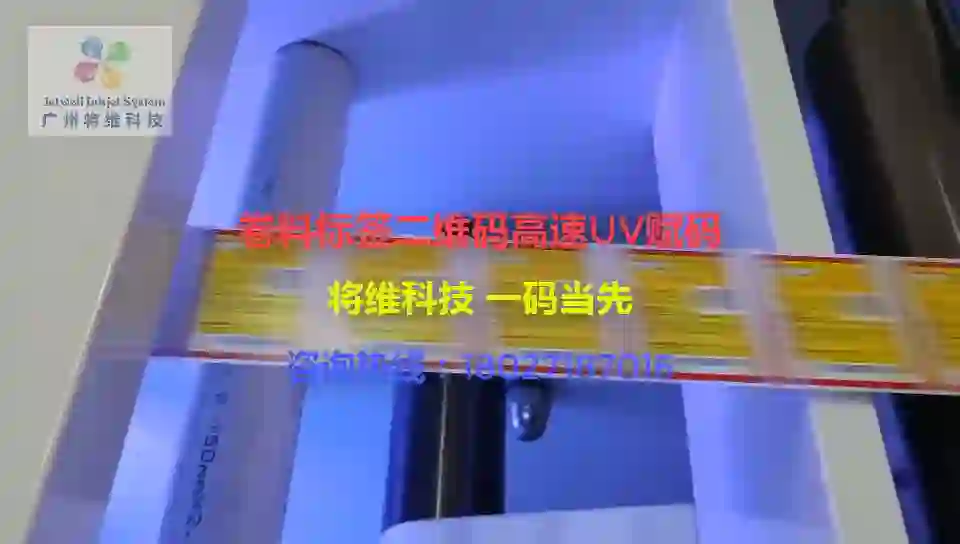
- Video confirms continuous label-web movement, variable QR artwork, UV curing, rewind handling and active control screens. A guaranteed metres-per-minute value is not stated without a signed test record.
Direct answer
Variable QR codes can be printed on roll labels at production speed when web control, data generation, print resolution and UV curing are balanced as one system. This demonstration shows the moving label web, printing and curing modules, rewinding and live controls, giving buyers enough evidence to evaluate the workflow while avoiding a speed claim detached from material and code quality.
Documented application evidence
The video records yellow preprinted labels passing through the UV inkjet area and returning to a roll. Control screens show an active print job and changing counters. These details confirm a working variable-label process, not merely a static QR-code sample.
Some numeric values are visible on the screens, but they are not published as specifications because the video does not connect each value to a calibrated line-speed test and a documented code grade. That distinction keeps the case useful and technically defensible.
Application overview
| Application | Continuous variable QR-code printing on label web |
|---|---|
| Input | Preprinted labels with a reserved variable-data zone |
| Data | Unique or batch-linked QR codes and supporting text |
| Synchronization | Encoder plus label repeat/registration signal |
| Output | UV-cured web rewound for later converting or application |
| Performance claim | Confirmed by application test, not inferred from screen values |
Customer requirement and production challenge
High-speed label work puts pressure on every part of the process. The printer must create and rasterize new codes quickly, fire them at the correct repeat, cure sufficient ink before contact and keep the web stable. Increasing speed without checking all four can produce apparently sharp codes that fail later inspection.
QR-code density also matters. A small high-data symbol has finer modules than a larger low-data symbol. The buyer's actual URL or serialized payload must therefore be tested at final size instead of using a generic demonstration code.
Inkjetwell integration approach
The job begins with the label pitch, variable zone and data format. Encoder feedback follows web travel; the registration signal establishes the print origin; and the controller generates a new image for each label. UV power and distance are adjusted so the cured mark reaches downstream rollers without smearing or blocking in the roll.
For reliable production, the operator checks the first label after acceleration, the last label before a stop and the first label after restart. Optional inspection can verify decode or compare content with the expected record.
Demonstrated outcome
The footage demonstrates continuous QR-code label production with the associated machine controls visible. It is strong evidence that the system can operate as part of a rewinding workflow and that variable content is managed through production software.
The publishable result is intentionally framed as a verified process rather than a record-setting speed. Buyers receive a realistic basis for a sample test and a final acceptance target tied to their own label.
What this case does not claim
No single speed should be applied to all code sizes, label stocks and inspection requirements. The accepted value belongs in the quotation and factory-acceptance test for the defined job.
A smartphone scan is useful during development but does not replace a verifier when a formal barcode grade is required.
Production validation checklist
- Provide the real QR payload and error-correction setting.
- State final symbol size, quiet zone and background artwork.
- Identify web material, topcoat and later finishing steps.
- Test at low speed, target speed and controlled overspeed.
- Check first-after-start and first-after-restart labels.
- Agree whether acceptance is visual, decode-based or formally graded.
Common buyer questions
What determines the maximum QR-code printing speed?
Code size, data complexity, number of lanes, ink coverage, head configuration, curing and inspection all contribute. The web transport alone is not the answer.
Can every QR code link to a different URL?
Yes. The controller can generate unique URLs or tokens from a database when record order and error handling are defined.
Can preprinted color labels be used?
Yes when the variable zone provides sufficient contrast and the topcoat accepts the selected UV ink.
Will the system work with a buyer's existing rewinder?
Often, subject to a survey of tension, registration, mounting space, encoder access, curing and operator safety.
Request an application test
Send Inkjetwell the actual production material or parts, final-size artwork, required print position and width, line speed range, product spacing, line photos or video, variable-data format, scanner requirements and required resistance tests. We will use those details to propose the printhead arrangement, transport or retrofit method, sensing, UV curing, data workflow and inspection plan.
Media evidence note: the images and videos on this page document Inkjetwell application samples or production configurations supplied for this case library. Customer identities are withheld unless separately authorized. Visible third-party marks remain the property of their owners and do not imply endorsement.