


- Market / location
- China — Dongguan production application; customer identity withheld
- Product / substrate
- Small rigid plastic boxes with controlled top or side print zones
- Verified result
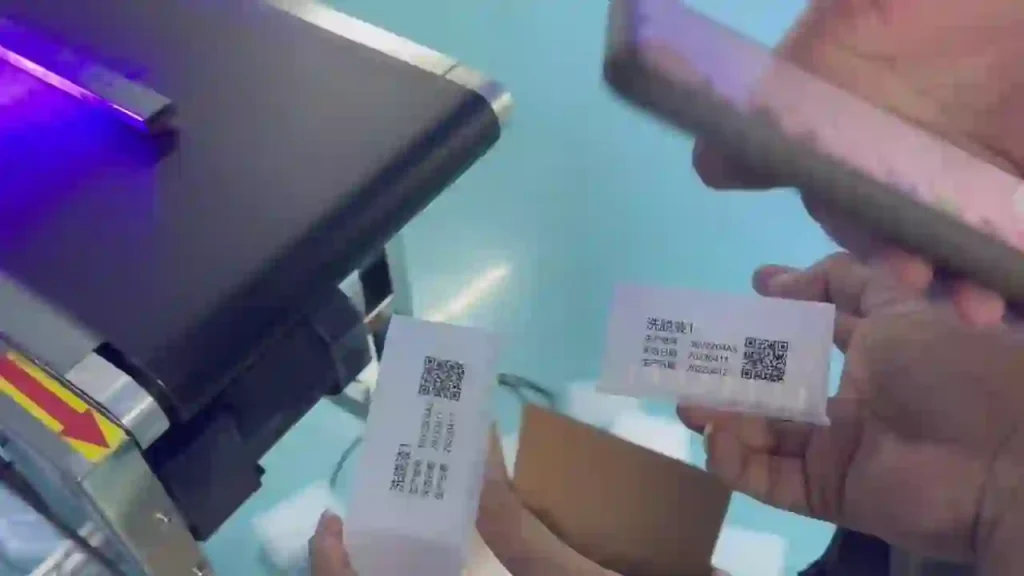
- Two production clips confirm conveyor handling, direct print, UV curing and visible variable QR/text output. One clip shows a JW6000-labelled installation and a smartphone code check.
Direct answer
Rigid plastic boxes can receive changing QR codes, barcodes, serials, batch text or compact graphics directly on an approved top or side surface. The supplied footage shows both orientations and confirms that the print system can be built around the part geometry rather than requiring an adhesive label.
Documented application evidence
The side-printing video shows controlled part presentation, print and cure, the resulting variable QR/text and a smartphone check. A machine label in the footage reads JW6000; this article does not infer specifications beyond the visible installation.
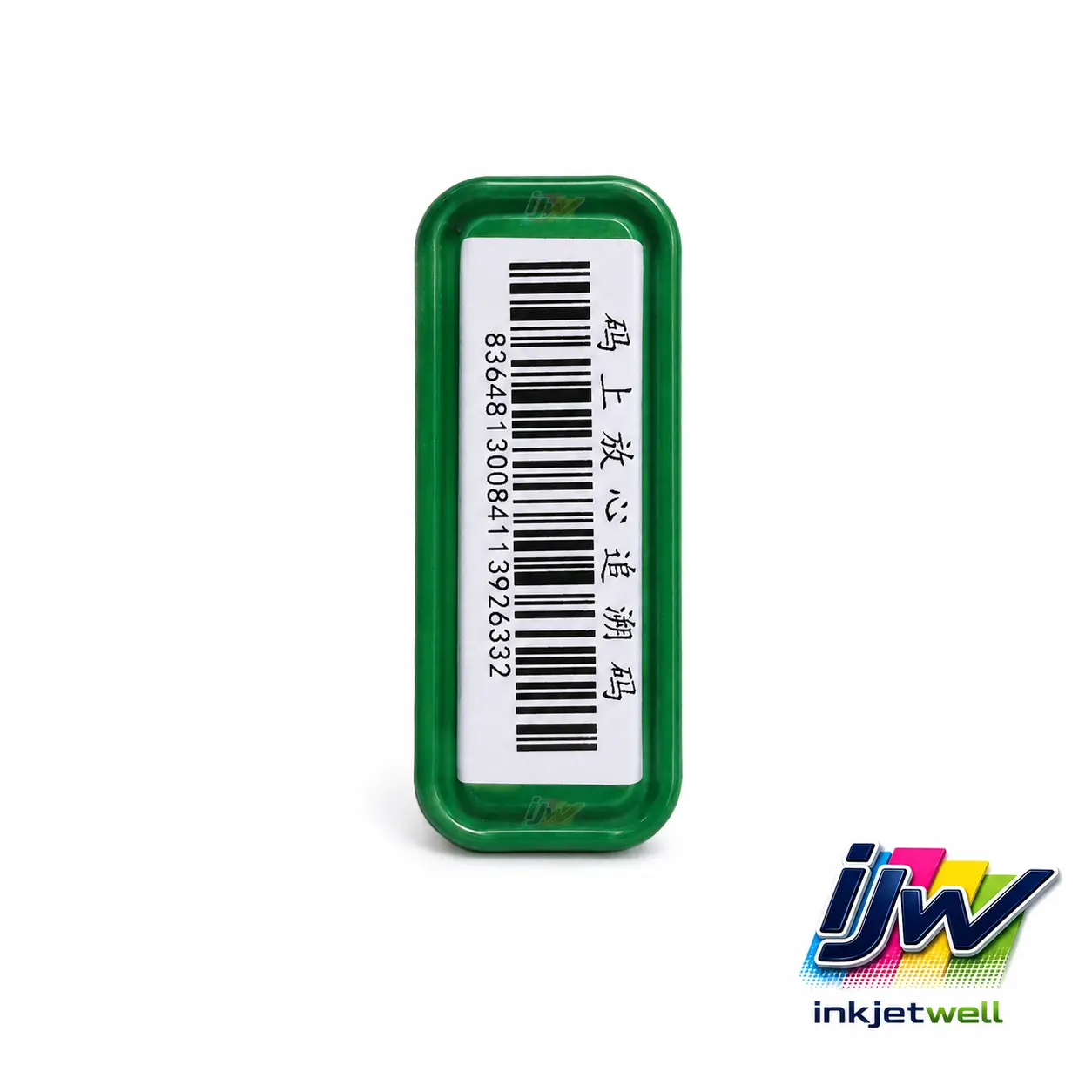
A second Dongguan clip documents another box-transport arrangement. The close-up green plastic sample adds evidence for dense linear-barcode output on a narrow rigid-plastic zone.
Application overview
| Application | Direct variable printing on rigid plastic boxes |
|---|---|
| Orientation | Top or side surface |
| Content | QR, barcode, serial, batch text and small graphics |
| Handling | Guided conveyor or indexed fixture |
| Curing | UV immediately after printing |
| Evidence | Two production videos plus one close-up sample |
Customer requirement and production challenge
Small boxes can rotate, lean or vary in molding height. Side printing adds the need to control lateral distance, while glossy plastic may have low surface energy and insufficient natural adhesion.
A readable code also needs quiet zone and contrast. Rounded corners, molded ribs and dark base colors can reduce the usable print area.
Inkjetwell integration approach
The first step is part control: guides, pockets or fixtures keep the print face at a consistent position and distance. Sensing confirms part presence, encoder or indexed motion controls image timing, and the cure lamp is aligned to the same face.
The exact polymer and any release agent are tested. Pretreatment, ink channel and UV setting are selected from adhesion, rub and scan results rather than appearance alone.
How buyers can use this evidence
For a similar project, mark one photograph with the permitted print zone and send several parts showing normal molding variation. The side-printing footage helps the buyer judge whether the part can be guided without rotation and whether the print face remains within a controlled distance. The close-up barcode sample can be used to define minimum element size and contrast. These inputs let Inkjetwell quote the handling and printing as one system rather than treating the box as a flat generic plastic sample.
Demonstrated outcome
The videos demonstrate practical top and side implementations and show that variable code content remains visible after curing. The sample image demonstrates dense barcode and text placement on another narrow plastic component.
Together, the assets support direct-to-plastic capability while keeping the production claim limited to the documented geometries and tested material recipe.
What this case does not claim
Plastic type cannot be identified reliably by appearance. PP, PE, PET, ABS and coated parts may require different preparation and ink.
A smartphone read in a video is useful evidence but is not a substitute for the buyer's formal barcode-verification requirement.
Production validation checklist
- Identify polymer, additives, coating and mold-release conditions.
- Provide parts from normal production, not only clean laboratory samples.
- Mark top or side print zone and acceptable orientation.
- Measure height, curvature and position variation.
- Test adhesion, rub, chemical exposure and scanner performance.
- Confirm fixture, sensor, cure and reject behavior at target rate.
Common buyer questions
Can UV inkjet print on PP or PE boxes?
Potentially, but low-surface-energy plastics often need pretreatment and an approved ink recipe.
Can the printer code the side instead of the top?
Yes when guides or fixtures hold the side face at a controlled distance from the printhead.
Can every box carry a unique QR code?
Yes when part detection and the variable-data queue remain synchronized.
Does direct printing remove the need for labels?
It can for the approved information and surface, but the buyer decides whether other label functions are still required.
Request an application test
Send Inkjetwell the actual production material or parts, final-size artwork, required print position and width, line speed range, product spacing, line photos or video, variable-data format, scanner requirements and required resistance tests. We will use those details to propose the printhead arrangement, transport or retrofit method, sensing, UV curing, data workflow and inspection plan.
Media evidence note: the images and videos on this page document Inkjetwell application samples or production configurations supplied for this case library. Customer identities are withheld unless separately authorized. Visible third-party marks remain the property of their owners and do not imply endorsement.