


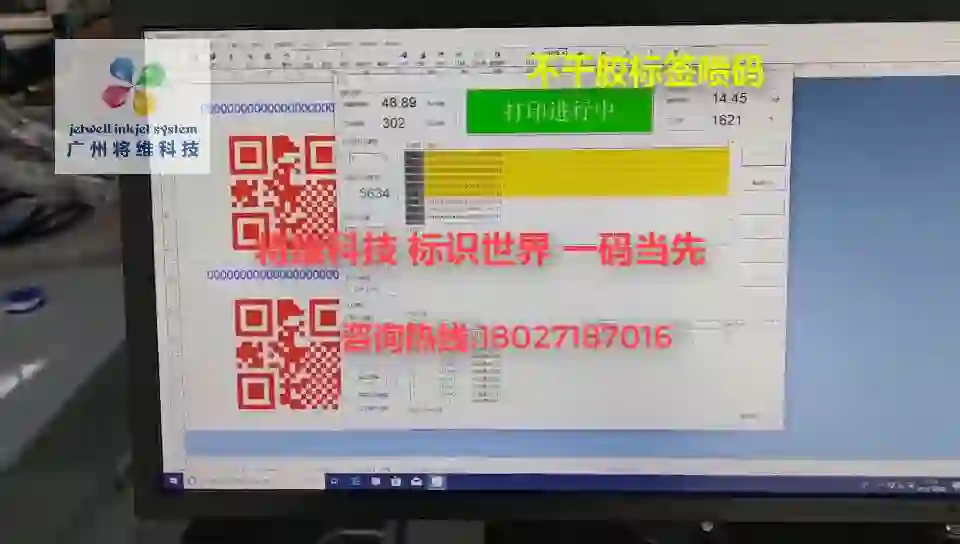
- Market / location
- China — multiple label demonstrations and installations
- Product / substrate
- Paper and synthetic pressure-sensitive labels on release liner
- Verified result
- Four videos confirm several roll-path configurations, repeated QR/barcode output, UV curing and production software. Material-specific adhesion and maximum speed require separate approval.
Direct answer
Self-adhesive labels can receive changing QR codes, barcodes, numbers and text after the fixed design has been printed. This case groups four complementary videos because they document different parts of the same application: a longer self-adhesive label run, a compact roll platform, an alternative vertical web path and a close view of repeated barcode-label output.
Documented application evidence
Together, the videos show that Inkjetwell systems have been integrated around more than one rewinder geometry. They document the control computer, sensors, print position, UV exposure, web rollers and finished label web. Grouping them in one case is more useful than publishing four thin pages with nearly identical claims.
The media also shows why the base machine matters. A compact platform may be appropriate for sampling and short production, while a larger rewinder provides more tension control and roll capacity. The print process must be matched to the mechanical platform.
Application overview
| Application family | Offline or inline variable printing on self-adhesive labels |
|---|---|
| Possible substrates | Coated paper, PET, PP and other approved face stocks |
| Content | QR codes, linear barcodes, serials, dates and text |
| Registration | Label gap, printed mark or repeat signal |
| Configurations shown | Compact platform, vertical path and production rewinder |
| Finishing | UV curing before rewinding or later converting |
Customer requirement and production challenge
Self-adhesive label is a construction, not one material. The face stock, topcoat, adhesive, liner and any overlaminate influence web behavior and ink adhesion. A label that prints well as a flat sample may behave differently under rewind pressure or later die cutting.
Converters also need changeover flexibility. Label pitch, web width and variable field location can change between jobs, so guides, sensor position, image origin and saved recipes must be accessible without creating an unstable manual process.
Inkjetwell integration approach
The web is guided through a stable print span, with encoder feedback for movement and a repeat signal for image origin. Inkjetwell positions the printhead and UV source so fresh ink is cured before contact. Job software imports or generates the changing data and stores the approved print position.
On multi-lane jobs, the controller maps records across the width. On single-lane jobs, the same architecture can combine fixed text with a changing code. The customer decides whether the final roll is inspected online, sampled periodically or verified downstream.
Demonstrated outcome
The four videos provide a broader evidence base than one showcase clip: they confirm several machine layouts and show actual repeated labels rather than only a digital design. This supports an application-led conversation about the buyer's web and finishing process.
A final project should still be quoted from the real roll sample. Surface treatment, coverage and resistance targets determine ink and curing, while lane count and print width determine head configuration.
What this case does not claim
The case does not combine screen counters from different videos into a claimed throughput. Each installation has its own material and operating window.
No universal adhesion statement is made for all self-adhesive label stocks. The final label construction must pass rub, tape, laminate and storage tests appropriate to the product.
Production validation checklist
- Send one complete roll with liner, not only loose face-stock sheets.
- Provide web width, pitch, gap, winding direction and core size.
- Identify topcoat, overprint varnish and planned lamination.
- Define variable fields and supply representative production data.
- Test rewind blocking and downstream die-cutting or application.
- Record approved recipes by SKU or material family.
Common buyer questions
Can UV inkjet print on both paper and film labels?
Yes on compatible materials, but paper and film require separate wetting, adhesion, curing and finishing tests.
Can a compact roll platform be used for production?
It can suit sampling, short runs or controlled production when roll size, tension, speed and inspection requirements fit the platform.
Can fixed and variable content be printed together?
Yes. A job can combine a fixed logo or text field with a different code, date or serial on each label.
Do labels need a registration mark?
A mark is one option. Some jobs use label gaps, existing artwork features or another reliable repeat signal.
Request an application test
Send Inkjetwell the actual production material or parts, final-size artwork, required print position and width, line speed range, product spacing, line photos or video, variable-data format, scanner requirements and required resistance tests. We will use those details to propose the printhead arrangement, transport or retrofit method, sensing, UV curing, data workflow and inspection plan.
Media evidence note: the images and videos on this page document Inkjetwell application samples or production configurations supplied for this case library. Customer identities are withheld unless separately authorized. Visible third-party marks remain the property of their owners and do not imply endorsement.