






- Market / location
- Inkjetwell equipment demonstration and application integration
- Product / substrate
- Flat printed sheets and multi-up packaging blanks compatible with the feeder
- Verified result
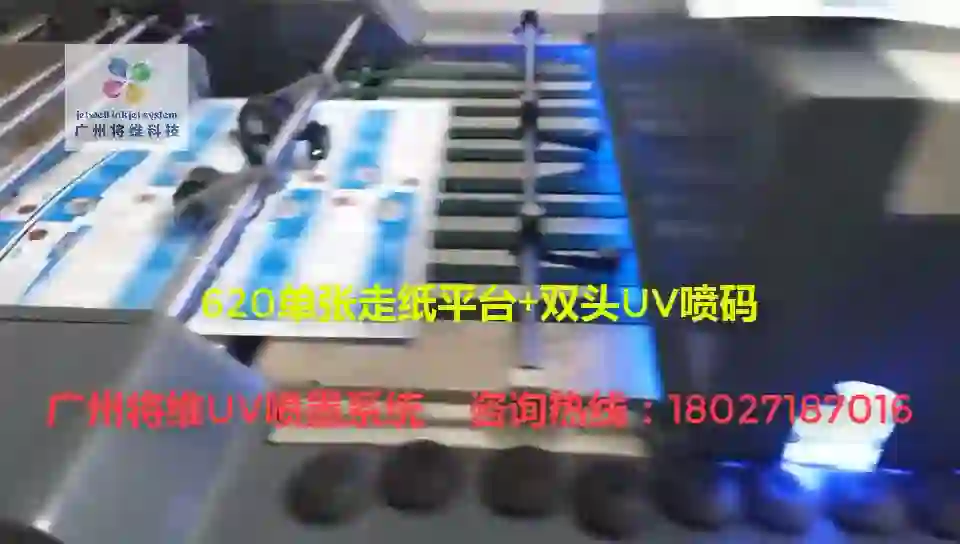
- Video confirms a 620 mm sheet transport, two installed print modules and inline UV hardware. Substrate, speed and grade must be confirmed per job.
Direct answer
The 620 mm sheet-fed platform provides a dedicated transport when a buyer cannot or does not want to modify the original printing press. Two UV inkjet modules can be positioned for separate lanes, repeated package panels or a wider coordinated layout, while the conveyor supplies the controlled movement required for variable data.
Documented application evidence
The equipment video shows the feeder/transport width, two print assemblies, guarding and UV curing hardware. It is direct evidence of the platform architecture.
The footage is not used to infer a substrate-specific maximum speed because sheet stiffness, size, coverage and feeding behavior materially change the acceptable rate.
Application overview
| Platform | 620 mm sheet-fed transport |
|---|---|
| Print arrangement | Two adjustable UV inkjet modules |
| Typical jobs | Multi-up cartons, cards, sleeves and flat packaging sheets |
| Content | QR, barcode, serial, text and monochrome graphics |
| Workflow | Feed, detect, print, cure and collect |
| Evidence | Equipment operation video |
Customer requirement and production challenge
Loose sheets require reliable separation and a repeatable leading edge. Double feeds, skew and curl can move variable content outside the designated panel.
A two-head layout also needs a clear data map: the modules may print separate lanes or coordinated parts of one job, and the software must preserve that relationship through every sheet.
Inkjetwell integration approach
Material trials determine feeder settings, guide position, sensor location and usable print distance. Encoder tracking follows the transport, while the job layout assigns each variable field to the correct head and sheet position.
The UV cure is checked before collection or stacking. If sheets contain several finished packages, data allocation and finishing order are documented so each code remains associated with the intended product.
How buyers can use this evidence
This case is most relevant when the buyer needs an offline variable-data step for imposed sheets. The two-head video confirms the platform concept; the buyer should then map every finished panel on the 620 mm sheet and identify whether each head prints independent lanes or coordinated content. A sample pack should include the easiest sheet and the most difficult curled or static sheet. That comparison determines feeder settings, usable margins, head placement and whether the platform can preserve data order through finishing.
Demonstrated outcome
The demonstrated platform creates a standalone path for sheet-fed variable printing without relying on a customer's press to provide the transport. The dual-head configuration supports multiple print zones within the 620 mm working format.
It is suitable as an engineering base, not a promise that every 620 mm sheet uses the same setup. Feed stability and printable layout remain job-specific.
What this case does not claim
The nominal platform width does not mean edge-to-edge printable coverage. Head coverage, margins and module positions are defined in the approved layout.
Bent, highly static or very thin sheets may need a different feeding method or additional hold-down control.
Production validation checklist
- Provide minimum and maximum sheet size and thickness.
- Send samples including worst-case curl or static.
- Mark all variable zones on the imposed sheet.
- Define two-head data allocation and finished-product order.
- Test feeding, cure, stacking and scan performance.
- Record changeover settings for each sheet family.
Common buyer questions
Does 620 mm mean the print width?
No. It describes the transport format; actual print coverage is determined by the selected heads and their positions.
Can the two heads print different information?
Yes. They can receive separate records or coordinated parts of one job according to the layout.
Can preprinted sheets be used?
Yes, after their coating, varnish and background contrast pass application testing.
Can this run offline from the main press?
Yes. A dedicated sheet-fed platform is commonly used as a separate variable-data production step.
Request an application test
Send Inkjetwell the actual production material or parts, final-size artwork, required print position and width, line speed range, product spacing, line photos or video, variable-data format, scanner requirements and required resistance tests. We will use those details to propose the printhead arrangement, transport or retrofit method, sensing, UV curing, data workflow and inspection plan.
Media evidence note: the images and videos on this page document Inkjetwell application samples or production configurations supplied for this case library. Customer identities are withheld unless separately authorized. Visible third-party marks remain the property of their owners and do not imply endorsement.