




- Market / location
- Inkjetwell compact-line application demonstration
- Product / substrate
- Individually fed flat cards, sleeves, pouches or components compatible with friction separation
- Verified result
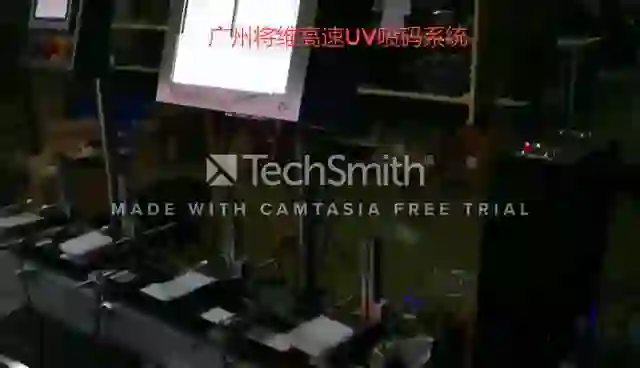
- Video confirms product separation, controlled conveying, an inline print position and UV curing. The exact substrate in the clip is not identified and is not asserted.
Direct answer
A friction feeder converts a stack of flat products into a consistent single-piece stream for UV inkjet coding. This compact architecture is useful when the product is not supplied on a continuous roll and the buyer needs variable QR codes, barcodes, dates, serials or text without a large press retrofit.
Documented application evidence
The video follows the stack, separation point, conveyor, print zone and UV cure, confirming the complete material path.
Because the material record is unavailable, the case deliberately describes the handling method rather than guessing whether the pieces are paper, film, card or another flat product.
Application overview
| Application | Offline feeding and variable coding |
|---|---|
| Handling | Friction separation plus belt transport |
| Products | Flat pieces that can be separated without damage |
| Data | Changing QR, barcode, number, date or text |
| Curing | Inline UV after the print zone |
| Evidence | Complete process video |
Customer requirement and production challenge
Hand feeding is difficult to keep consistent and creates avoidable registration and labor variation. A feeder must separate one piece at a time without scratching, double-feeding or changing orientation.
Glossy, static, very thin or irregular products can behave differently even when their size is similar. The feeder setting and ink recipe must therefore be approved together.
Inkjetwell integration approach
Inkjetwell tests stack height, friction, static and leading-edge consistency, then positions the guides and sensor for the real product. The printhead is mounted over a stable belt span and encoder feedback tracks actual movement.
Job controls define record order and behavior for double feed, missing product or a planned pause. UV exposure is set so the result is cured before it reaches the collection tray or contacts another piece.
How buyers can use this evidence
Use the footage to decide whether your product behaves like a feedable flat piece. The important evidence is not only the printed mark but the clean separation of one product from the stack. Send a short video of the product being hand-separated, plus a normal production stack, to expose static, surface damage or double-feed risk. Inkjetwell can then test the complete sequence and recommend friction, vacuum or fixture-based handling before finalizing printhead and curing hardware.
Demonstrated outcome
The video demonstrates a compact feed-print-cure workflow suited to many short-run or mixed-product applications. It gives small and medium manufacturers a practical automation step without requiring roll conversion.
Change parts and saved settings can support several approved formats, but each product remains subject to feeding and adhesion validation.
What this case does not claim
Not every flat item is suitable for friction feeding. Sensitive surfaces, very soft pouches or parts with large thickness variation may require vacuum feeding or fixtures.
The case does not assign a speed because feeding stability and ink coverage govern the production rate.
Production validation checklist
- Provide at least a representative production stack.
- Identify scratches, marks or orientation that are unacceptable.
- Specify product dimensions and thickness range.
- Define variable data and duplicate-control rules.
- Test separation, registration, cure and collection.
- Approve operator loading and jam-clearing procedures.
Common buyer questions
What products can a friction feeder handle?
Many flat cards, sleeves and packaging pieces can be handled, but the actual surface, stiffness and static behavior must be tested.
Can every piece receive unique data?
Yes when the feeder sensor and data queue stay synchronized.
Can the same machine run several sizes?
Often yes with adjusted guides and saved job settings, subject to the feeder's verified range.
What if the product cannot be friction-fed?
Inkjetwell can evaluate vacuum transport, fixtures or an existing conveyor instead.
Request an application test
Send Inkjetwell the actual production material or parts, final-size artwork, required print position and width, line speed range, product spacing, line photos or video, variable-data format, scanner requirements and required resistance tests. We will use those details to propose the printhead arrangement, transport or retrofit method, sensing, UV curing, data workflow and inspection plan.
Media evidence note: the images and videos on this page document Inkjetwell application samples or production configurations supplied for this case library. Customer identities are withheld unless separately authorized. Visible third-party marks remain the property of their owners and do not imply endorsement.