





- Market / location
- China — production label installation; customer anonymized
- Product / substrate
- Die-cut pharmaceutical pressure-sensitive labels on a roll web
- Verified result
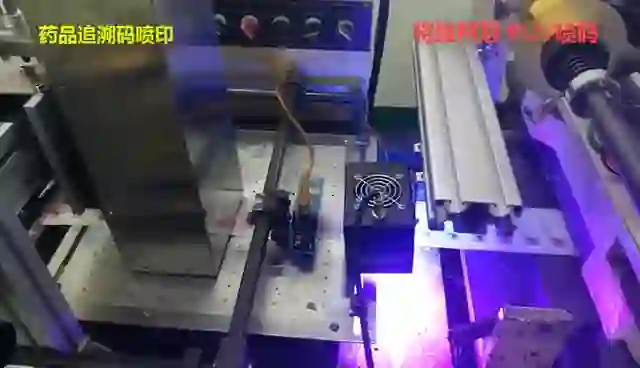
- Video confirms roll transport, variable barcode content, UV curing, repeated label output and an inspection-software interface. Formal code grade and production speed are not claimed.
Direct answer
UV inkjet can add variable barcodes, serial identifiers and human-readable pharmaceutical data to preprinted labels during rewinding. The supplied installation video shows the complete working sequence: job data on the control screen, labels moving through the print and cure zone, repeated output on the web and an inspection interface comparing the printed label area.
Documented application evidence
Unlike a static sample, this footage shows the relationship between software, web transport and printed output. Barcode images and label records are visible on screen, while the production section shows the UV source and continuous roll movement.
The video supports an inspection-enabled workflow but does not prove a specific grading standard. A camera preview, barcode decode and ISO grade are different acceptance levels and must be specified by the buyer.
Application overview
| Application | Variable pharmaceutical-label printing during rewinding |
|---|---|
| Substrate | Pressure-sensitive label face stock on release liner |
| Content | Linear barcodes, product text, serial and batch data |
| Registration | Web movement plus label pitch/mark control |
| Quality control | Visible inspection interface; acceptance rule project-specific |
| Finishing | Rewind after UV curing and inspection |
Customer requirement and production challenge
A pharmaceutical label web can contain thousands of sequential records. Registration must stay centered on each die-cut label while data order remains correct during acceleration, deceleration, roll changes and waste removal. A readable mark with incorrect data is still a production failure.
Face stocks vary from paper to coated film. Topcoat, adhesive construction, later lamination and rewind pressure can all change the required ink and curing window. Approval must cover the complete label construction, not just a loose sample sheet.
Inkjetwell integration approach
The printer is placed where web tension and lateral position are stable. Encoder feedback synchronizes image length, while a label gap or registration mark establishes repeat position. The UV lamp cures the printed area before it reaches rollers or the rewind pack.
Inspection can compare expected and printed records, confirm barcode decode or grade the symbol under a defined method. The controller also needs a rule for stopped webs, splice areas and labels removed during setup so that the database remains aligned with physical product.
Demonstrated outcome
The documented line demonstrates variable barcodes produced repeatedly on a roll label format and provides visual evidence of the accompanying inspection workflow. That combination is more useful to a pharmaceutical buyer than an isolated claim about resolution.
The architecture can be adapted to other traceability labels, but each label pitch, material and data format requires a saved and approved job setup.
What this case does not claim
The screen values visible in a video are not adopted as guaranteed throughput. Production speed must be confirmed with the exact web, coverage, curing and inspection workload.
Inkjetwell does not certify the pharmaceutical content. The customer controls artwork approval, regulatory data, retention records and final release.
Production validation checklist
- Provide label width, pitch, gap, number of lanes and roll direction.
- Identify face stock, topcoat, liner and any later lamination.
- Define the data source and rules for waste, splice and restart.
- State whether inspection means presence, decode, content match or grade.
- Test rewind contact and downstream converting resistance.
- Approve a retained roll section at production conditions.
Common buyer questions
Can every label receive a different barcode?
Yes. The system can consume sequential or database-linked records and print a different barcode and text set on each registered label.
Can the camera verify the data, not just see the code?
Yes when the expected record is available to the inspection workflow. The comparison logic and rejection or stop response must be defined during engineering.
Can UV inkjet labels be laminated afterward?
Potentially, but the selected ink, cure, face stock and laminate must be tested through the buyer's complete converting process.
Does roll speed change print length?
Encoder synchronization compensates for normal speed change within the designed range. Slip, web stretch and poor tension still need mechanical control.
Request an application test
Send Inkjetwell the actual production material or parts, final-size artwork, required print position and width, line speed range, product spacing, line photos or video, variable-data format, scanner requirements and required resistance tests. We will use those details to propose the printhead arrangement, transport or retrofit method, sensing, UV curing, data workflow and inspection plan.
Media evidence note: the images and videos on this page document Inkjetwell application samples or production configurations supplied for this case library. Customer identities are withheld unless separately authorized. Visible third-party marks remain the property of their owners and do not imply endorsement.