



- Market / location
- China — Nantong installation; customer identity withheld
- Product / substrate
- Multi-lane pressure-sensitive labels on a rewinder web
- Verified result
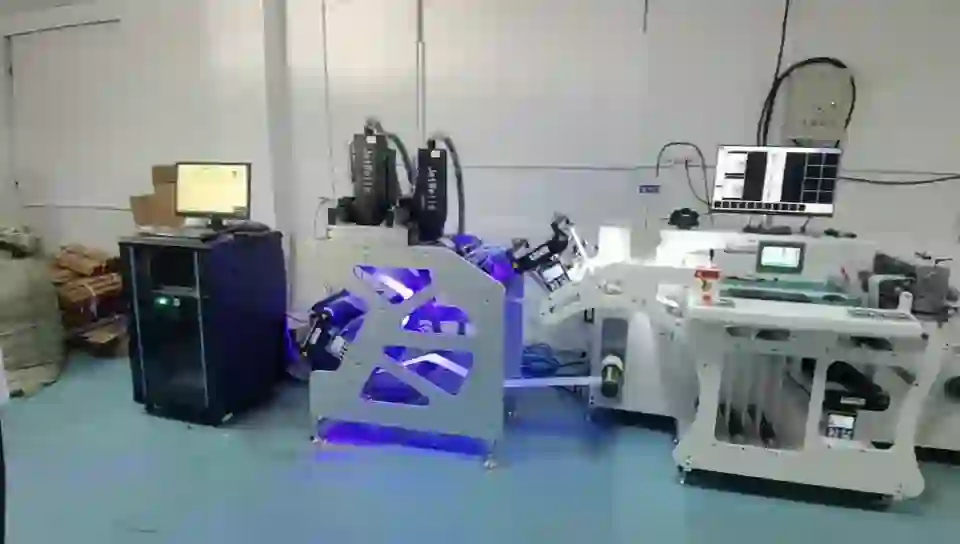
- Production footage confirms a three-head rewinder layout, barcode artwork on multiple label positions, UV curing and finished web handling. No unverified speed figure is published.
Direct answer
A three-head UV inkjet rewinder can serve separated lanes or repeated variable-print zones on a label web. In the Nantong installation shown here, the coding system is integrated with the unwinding, transport and rewinding process so barcodes and text can be added to preprinted labels without sending the web through another conventional press.
Documented application evidence
The production video shows barcode-label artwork on the control display, the three-head machine arrangement, web movement and printed multi-up labels. The footage also reveals the practical details a still image cannot show: roller contact, operator access, curing position and how the web enters and leaves the print section.
The three-head description comes from the installation record and visible configuration. The article does not assign an IJW printhead platform because the model label is not clear enough to verify from the supplied media.
Application overview
| Base machine | Label unwinder/rewinder |
|---|---|
| Print layout | Three controlled UV inkjet zones |
| Typical content | Variable barcodes, QR codes, serials and text |
| Web control | Tension, lateral guidance, pitch registration and encoder |
| Curing | UV before critical roller or rewind contact |
| Configuration status | Head platform selected from confirmed job data |
Customer requirement and production challenge
Multi-lane labels magnify small web errors. Lateral wander can move every printed code at once, while an incorrect pitch setting gradually shifts the image down the roll. A data workflow must also know which lane consumes which record at every repeat.
The rewinder is not only a transport. Tension, roller wrap and rewind pressure influence registration and whether recently cured ink contacts another surface. Mechanical settings must be approved together with the print recipe.
Inkjetwell integration approach
Head positions are established from the actual lane map. A registration sensor or label-gap signal finds each repeat; an encoder follows web movement; and the controller assigns the required record to each zone. UV curing is placed before the web reaches a contact point that could mark an incompletely cured image.
For job changeover, the operator needs saved settings for web direction, pitch, lane offsets, data file, curing and inspection. Clear job naming reduces the risk of loading the correct artwork with the wrong database.
Demonstrated outcome
The video-documented installation demonstrates multi-zone barcode printing on a working rewinder and shows that the three-head layout is tied to the web design. It is a strong reference for label converters evaluating an offline variable-data stage.
A similar architecture can print one, two or more lanes, but the final configuration should be calculated from artwork coverage and spacing rather than copied from this installation.
What this case does not claim
The case does not publish a maximum speed because the supplied evidence does not connect a verified speed to a specific material, ink coverage, code grade and inspection load.
Printed examples in the video are used to demonstrate capability. Trademark ownership and regulatory approval remain with the respective product companies.
Production validation checklist
- Send a full-width web diagram with lane centers and print zones.
- Specify label pitch, gap, matrix condition and winding direction.
- Describe acceleration, stop, splice and waste-handling behavior.
- Test the exact topcoat and any overlaminate.
- Define how records are allocated across the three heads.
- Confirm operator access for cleaning and printhead adjustment.
Common buyer questions
Can the three heads print independent data?
Yes. Each print zone can receive its own variable record or a coordinated portion of one layout, depending on the controller and job map.
Can a rewinder be upgraded after purchase?
Often yes when it provides stable web control, usable mounting space, encoder access and a safe location for UV curing.
What happens when the web stops?
The system needs stop and restart rules that prevent overprinting and preserve data order. Those rules are tested with the actual rewinder controls.
Can the same line print paper and film labels?
It may, but paper and film face stocks need separate adhesion, curing, tension and finishing validation.
Request an application test
Send Inkjetwell the actual production material or parts, final-size artwork, required print position and width, line speed range, product spacing, line photos or video, variable-data format, scanner requirements and required resistance tests. We will use those details to propose the printhead arrangement, transport or retrofit method, sensing, UV curing, data workflow and inspection plan.
Media evidence note: the images and videos on this page document Inkjetwell application samples or production configurations supplied for this case library. Customer identities are withheld unless separately authorized. Visible third-party marks remain the property of their owners and do not imply endorsement.